Ladies & Gents - For those of you who like to understand how their tools work, I have created the following (crude) diagrams to try to depict the geometry of the Slant.
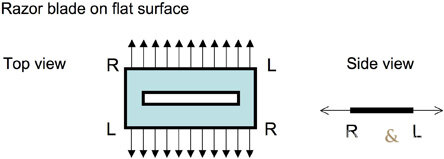
Here is a diagram of a razor blade, looked at from above, as if it was lying on a flat surface. The corners are labeled L and R for easier reference. On the right is an orthogonal, side view of one of the non-cutting edges. The arrows indicate the orientation of the cutting edge, or, in other words, the direction of the normals of the edge. In these two diagrams, the normals are in the plane of the paper.
Below are four diagrams each for a Classic razor (left) and the Slant (right).
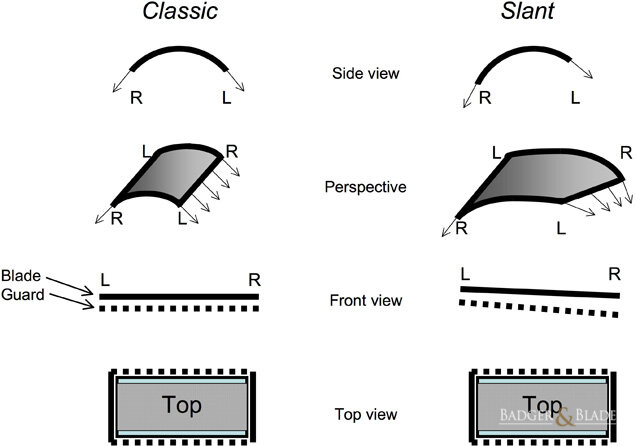
In a Classic, the blade is distorted such that the short, non-cutting edge is bent like an inverted U. The orientation of the cutting edges is thus pointing downwards. The perspective illustrates that the orientation is the same along the entire length of the edges. The front view illustrates that the cutting edge is straight. The guard is indicated. The top view shows that the edges of the blade (light blue) protrude slightly from underneath the top cap (grey). The guard is indicated.
In a Slant, the blade is not only bent but also twisted such that the R corners of the non-cutting edges are pointing lower than the L corners. Consequently, the direction of the cutting edges at the R corners is pointing lower than at the L corners. The perspective shows that the orientation of the cutting edge gradually changes along its length from the orientation at L to that at R. For a given edge, the arrow heads lie on a helical path. The helical axis is coincident with the cutting edge, which is thus straight as the front view indicates. In contrast to the Classic, the edge is slanted relative to the guard. When viewed from the top, the edges of the top cap, the blade edges and the guards are all parallel.
I cant tell whether the bend/twist in the Slant has an effect on the geometry of the edge. It probably depends on the type of razor blade used. If the blade edge is round, as most edges are, changing the orientation of the normals along the length of the edge will have no effect, provided the helical axis is close to the edge. If the helical axis lies further into the blade (for example, for a blade that is not very stiff), the edge itself would no longer be straight but would have a helical bend. I can only surmise that a non-straight edge is suboptimal for cutting hair, perhaps because stubble would be sliced off at different heights, and some portions of the edge might actually cut into the skin while other portions cut into stubble. Such effects, if present, would probably even out over the course of several passes.
If the edge is pointy, then the twist would indeed result in a helical path for the edge. I am not an expert on manufacturing cutting devices, but I believe pointy edges (at the microscopic level, which is of concern here) are very difficult to achieve. Still, different blades may have slightly different edge geometries.
Looking with the naked eye at my own Slant and using a ruler as reference, I could not detect any helical distortions of the cutting edge of a normal Feather blade. Joe Lerch examined the edge with a microscope, and he could also not see any helical distortion.
By contrast, it is undeniable (at least for my own Slant) that, when looked at edge-on, the distance between the guard and the cutting edge varies from left to right. Combined with the slant of the guard itself (relative to the direction of movement, i.e. the handle) this geometry results in a more economical slicing action of the blade, as opposed to the chopping action on a Classic. It is interesting to point out that the right sides of the cutting edges have a steeper edge angle and are thus more aggressive than the left sides. At the same time, the distance between the edge and the guard (and thus the exposure of the edge) is larger on the right side, thus making it even more aggressive. In other words, I believe the "aggressiveness" increases from left to right.
"Aggressive" here means that while the blade at the left side of the edge may be parallel to the skin and is thus cutting stubble horizontally, the blade edge at the right side is pointing towards the skin, either cutting the stubble at a lower point, cutting into the skin, or scraping along the skin surface.
Thats my story, and I'll stick to it (until someone comes up with cogent arguments to the contrary, in which case I will revise my opinion )
)
Best - MM
Here is a diagram of a razor blade, looked at from above, as if it was lying on a flat surface. The corners are labeled L and R for easier reference. On the right is an orthogonal, side view of one of the non-cutting edges. The arrows indicate the orientation of the cutting edge, or, in other words, the direction of the normals of the edge. In these two diagrams, the normals are in the plane of the paper.
Below are four diagrams each for a Classic razor (left) and the Slant (right).
In a Classic, the blade is distorted such that the short, non-cutting edge is bent like an inverted U. The orientation of the cutting edges is thus pointing downwards. The perspective illustrates that the orientation is the same along the entire length of the edges. The front view illustrates that the cutting edge is straight. The guard is indicated. The top view shows that the edges of the blade (light blue) protrude slightly from underneath the top cap (grey). The guard is indicated.
In a Slant, the blade is not only bent but also twisted such that the R corners of the non-cutting edges are pointing lower than the L corners. Consequently, the direction of the cutting edges at the R corners is pointing lower than at the L corners. The perspective shows that the orientation of the cutting edge gradually changes along its length from the orientation at L to that at R. For a given edge, the arrow heads lie on a helical path. The helical axis is coincident with the cutting edge, which is thus straight as the front view indicates. In contrast to the Classic, the edge is slanted relative to the guard. When viewed from the top, the edges of the top cap, the blade edges and the guards are all parallel.
I cant tell whether the bend/twist in the Slant has an effect on the geometry of the edge. It probably depends on the type of razor blade used. If the blade edge is round, as most edges are, changing the orientation of the normals along the length of the edge will have no effect, provided the helical axis is close to the edge. If the helical axis lies further into the blade (for example, for a blade that is not very stiff), the edge itself would no longer be straight but would have a helical bend. I can only surmise that a non-straight edge is suboptimal for cutting hair, perhaps because stubble would be sliced off at different heights, and some portions of the edge might actually cut into the skin while other portions cut into stubble. Such effects, if present, would probably even out over the course of several passes.
If the edge is pointy, then the twist would indeed result in a helical path for the edge. I am not an expert on manufacturing cutting devices, but I believe pointy edges (at the microscopic level, which is of concern here) are very difficult to achieve. Still, different blades may have slightly different edge geometries.
Looking with the naked eye at my own Slant and using a ruler as reference, I could not detect any helical distortions of the cutting edge of a normal Feather blade. Joe Lerch examined the edge with a microscope, and he could also not see any helical distortion.
By contrast, it is undeniable (at least for my own Slant) that, when looked at edge-on, the distance between the guard and the cutting edge varies from left to right. Combined with the slant of the guard itself (relative to the direction of movement, i.e. the handle) this geometry results in a more economical slicing action of the blade, as opposed to the chopping action on a Classic. It is interesting to point out that the right sides of the cutting edges have a steeper edge angle and are thus more aggressive than the left sides. At the same time, the distance between the edge and the guard (and thus the exposure of the edge) is larger on the right side, thus making it even more aggressive. In other words, I believe the "aggressiveness" increases from left to right.
"Aggressive" here means that while the blade at the left side of the edge may be parallel to the skin and is thus cutting stubble horizontally, the blade edge at the right side is pointing towards the skin, either cutting the stubble at a lower point, cutting into the skin, or scraping along the skin surface.
Thats my story, and I'll stick to it (until someone comes up with cogent arguments to the contrary, in which case I will revise my opinion
)Best - MM
Last edited by a moderator: