It appears you are not registered with B&B. To register for a free account and begin participating in the discussions, please click here.

Home Forums Reviews Wiki Chat FAQ CONTRIBUTE More  

» Online Users: 348
148 members and 200 guests
40boy, Aaron01, Aaron622, Alpedhuez55, ambrose, amishmotorboat, AndrewGWU, Antique Hoosier, arghblech, Audiolab, azmark, Azza, Barber-Eile, betat, BigRich, bigstick, biomesh, bkn, bladebuff, Bloodhound, bradyarz, brian1g, brianw, Broogiedad, CCMphysician, Ceri, coolbluewater, coughdrop, cstrother, cubert, Darjeeling Express, davecmu, davidaker, davnig, deepcdv, demaro, deshaveman, DogHair, Dpflaum, Drubbing, dsipari, Duamuteffe, Eelco, elizard, elosamurai, Emmett, Empty Words, FreezerBurns, ginantonix, gordolindsay, GsSixgun, gsurko, gth872, guenron, guitarslinger, Hawkeye5, heat sink, HeF, heirkb, Hodari D., hooteroc, Hreafn, icedoverfire, ironduke, james7604, jayhabe, JMan424, jpdunn01, kesmed, kossi, Leon, Londobule, Loner16, MajorBurnz, malice669, mark2cars, mark3d, markb, melyus, menemsha43, michiganlover, mihaispencer, Miles, mirrorimij, mnacikanar, mook, Mr. Scruffy, mrbear, mrscottishman, njpaddy, northpaw, norton, Nuclearbuddy, O.G., Ookla The Mok, oronzino, Pcwilly, PFunk, poorieuser, profsaffel, Pumpkin, RBE17, rdeakle, RichieZ22908, Rick'46, RickT, riooso, rsp1202, s1mp13m4n, SAFETYpin, salisburyyates, Scissors, scottb, seanomatopoeia, shavervinnie, shavewithbigelow, silverdet, Silverstar, Sir Jammy Fishpaste, SmoovD, ssultan, Sullybob, superbleu, swingerofbirches, tantousha, Texasfietser, texbilly, the beav, The Seeker, Thelonius1, theperfectstorm, TimMechEngr, Tony_B, Triumph Coupe, tweedcab, valmara1971, wdwrx, whereisandy, Wil Dorenbos, wolfrb, xriley, Yonjuro, zpb101
Most users ever online was 1,597, 09-11-2009 at 02:55 PM.
» Stats
Members: 23,423
Threads: 116,378
Posts: 1,711,883
Top Poster: ouch (21,171)
Welcome to our newest member, artus
» Wet Shaving FAQ
Wet Shaving FAQ
by Scotto


1.0 What is wet shaving?
2.0 What tools do I need?
3.0 Lathering up
4.0 Shaving with a DE
5.0 Post-shave treatment
6.0 Problems


1.0 What is wet shaving?

Wet shaving at its simplest, is just that – shaving with water, a razor blade, and some sort of lubricant (lather, soap, etc.) on your face. Men have shaved this way for centuries, starting early on with a sharp knife or stone, progressing to the straight razor, safety (double-edge) razors, and eventually cartridge razors from companies like Gillette, etc.

1.1 Why wet shave?

To remove facial hair, of course! Less facetiously, a closer shave can generally be had from a wet shave versus an electric razor. Perhaps more importantly, the ritual, scents, and connection to the past associated with using high-quality wet shaving products can turn what is generally viewed as a chore into something pleasurable. Many men also feel their skin quality is improved by the exfoliating nature of the wet shave and the moisturizing nature of the products used.

2.0 What tools do I need?

The fundamental tools of the trade are water (obviously), some sort of lubricant (usually shaving cream or soap) that can be used to form a lather, a brush to apply the lather, and a razor to remove the beard.

2.1 Razors

2.1.1 Double edge razors

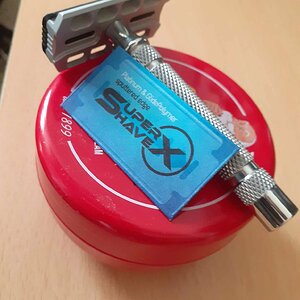
This is the kind of razor your father and grandfather most likely used. The razor itself is a thin, flexible, two sided metal blade made to be used in a safety razor. A safety razor holds the DE blade in place, and can be either fixed or adjustable in how much blade edge is exposed. Common brands include Merkur and vintage Gillette’s. The patent on Gillette’s safety razor dates to 1901.

2.1.2 Injectors

In 1921, Colonel Schick (who else?) invented a safety razor inspired by the army repeating rifle. It had replacement blades stored in a clip in the handle ready to be fed into shaving position by pivoting the head and stroking a built in lever, without the chore and danger of handling a sharp blade. This was the forerunner of the Schick Injector Razor, still made today. The razor blades are stored in a separate magazine, which is used to eject the old blade and inject the new one without touching a sharp blade.

2.1.3 Straight razors

Straight razors (cut-throats) are one of the first metal implements fashioned specifically for shaving. It is a sharp, open metal blade with a handle to protect and store it. It needs considerable care to keep sharp enough for shaving.

2.1.4 Cartridge razors

Disposable (fixed-head) and cartridge razors began to appear in volume in the 1960’s. Since then, there has been a proliferation of single, double, triple, and quadruple blade systems sold to the public.

2.1.5 Which razor should I use?

Much of this is personal preference. Most men on the planet shave with a disposable or cartridge razor with some sort of canned foam or gel. This has several issues: (1) cartridge razors are expensive, (2) aerosols used to dispense the cream or gel from the can are not good for the environment, and (3) a cartridge razor is made for the “average” male face, leaving little room for superior results. Furthermore, multi-blade razors can be quite irritating to many men due to repeated shaving of the same area by the multiple blades and the possibility of ingrown hairs due to the “lift and cut” operation.

The use of a double edge (DE) razor can alleviate many of these problems. They are quite cheap, extremely sharp, and when properly used can provide an extremely close shave with little or no irritation. The same can be said of straight razors, though they have a higher learning curve.

2.1.6 How long will one razor blade last?

Experience differs here, but a good average is to change your blade once a week. If you feel the blade skipping or nicking, then perhaps it is time to change it sooner.

2.2 Shaving Brushes

A shaving brush consists of a handle containing some sort of animal hair, usually boar or badger bristles. These animals are somewhat unique in that their hair absorbs water rather than repelling it. This allows water in the brush to mix with the shaving cream or soap to create a lather suitable for shaving.

2.2.1 Why use a brush?

The bristles in the brush aerate/hydrate the water and cream (or soap) to form lather. This is used to lubricate and protect the face during the shave. In addition the bristles have a mild exfoliating effect on the skin. Perhaps most importantly, the brush feels very good on the face – a very soothing feeling indeed when warm lather is applied.

2.2.2 What kind of brush should I get?

There are many types of brushes at many different price points. The handle should be comfortable to hold, and the bristles tightly packed. “Knot size”, or the diameter of the bristle mass at the handle end, is a measure of how large the brush is. Larger knot sizes make it easier to create large quantities of lather, but can be somewhat unwieldy on a small face. In the end, personal preference and aesthetics will determine what one person prefers versus another. A 22-26 mm knot size is a good starting point for many beginners.

2.2.3 Badger versus boar

Boar bristles are thicker, stiffer and hold less water than badger, and the brushes made from them are generally cheaper. Many men feel boar bristles are well suited to hard soap due to the stiffness of the bristles. Badger bristles, however, are much softer than boar and feel more luxurious on the face.

2.2.4 Where does badger hair come from?

Yes, the badger is killed to get the bristles. The badger is part of the food chain in China, and the bristles are harvested from the animal there.

2.2.5 Grades of badger hair

There are several grades of badger hair, but unfortunately the nomenclature is not standardized. Generally, “pure badger” is the lowest grade, coming from the back of the animal. Pure badger is a dark color, and is the least soft of the grades. “Finest (sometimes “best” or “super”) badger” is the middle grade, and has white tips with a dark band below. “Silvertip” is the highest grade, with very soft white bristles, also with a dark band below. Silvertip is harvested from the animal’s neck area.

2.2.6 Oooh that smell!

Shaving brushes come from animal hair, obviously, and new brushes sometimes have an unpleasant smell reminiscent of wet animals. This dissipates naturally over time, but can be improved by washing the brush in a small amount of shampoo or conditioner before use. Others use a mild Borax soak to eliminate the odor and clean the brush.

2.2.7 Brush Care

Your brush is getting a nice cleaning every time you use it to shave with. After shaving, rinse it out thoroughly with warm water until all the lather has been removed. Then flick the excess water out of it and you are done until it is ready for action next time. There is some debate over whether the brush should be stored in a stand with the bristles downward, or standing bristles up. Since cogent arguments (and long experience) exist on both sides of the argument, the best advice is to use whatever technique you wish.

2.3 Soaps and creams

A lather is formed by the aeration/hydration of a shaving cream or hard soap. A good soap/cream creates lather easily, lubricates and protects the face during the shave, and provides a pleasant aroma during the shave.

2.3.1 Types of soaps/creams

Soap making was an established craft in Europe by the seventh century, and were the first products used to create shaving lather. More than likely whatever hand/body soap was around the house was used to create a lather for shaving. Later, soaps specifically created for shaving were created. Shaving cream is even a more recent phenomenon, only having existed for the past two hundred years or so. Creams have a soft consistency, containing glycerin, naturally occurring saponified fats, and added scents. Hard soaps are generally poured into a container or formed into cakes.

2.3.2 What to look for

Men’s faces react quite differently to different products, so what works well for one person may not work for someone else. In general, the more lubricating the material is, the better the shave will be. Of secondary concern is the scent of the product. These fall into several categories, including floral, woody, cologne-scented, etc.

3.0 Lathering up

Regardless of whether you are using soap or cream, soak your brush in hot water. This warms the bristles and loads them with water. If you are using a bowl (see below), fill this with hot water also. Get your face nice and wet; it is best to shave after a shower, when your beard is at its softest. At the very least, apply a hot towel to your face for a few minutes before shaving. Then proceed to the sections below

3.1 Lathering with creams

Shake out some of the water from your brush. The water to cream ratio is something you will have to learn by experience, but starting out with less water is preferable, since you can always add more. Either scoop out some cream from the tub (about a teaspoon to start with), or dip your brush in the tub to pick up some cream. Swirl the brush on your face, in your hand, or in a bowl to generate nice, thick lather.

3.2 Lathering with soaps

Shake out some of the water from your brush. The water to soap ratio is something you will have to learn by experience, but starting out with less water is preferable, since you can always add more later. In general, you can start out with more water in your brush for a soap compared to a cream. Apply the hot, wet brush to the soap, press down a bit, and swirl 15 or 20 times on the soap. Swirl the brush on your face, in your hand, or in a bowl to generate nice, thick lather. Some people pour hot water on the soap and let it sit for a minute before pouring it off and lathering.

3.3 Bowl v. face v. hand lathering

This is a matter of preference. Lathering in a bowl generally creates more lather. Some people like to lather directly on their face, or in their hand. Try them all and figure out what works best for you.

4.0 Shaving with a DE

The first shave with a double edge razor can be somewhat frightening. Follow these steps and you will get a close, irritation-free shave. First, get your face very wet and lather up as discussed above. Again, after a shower your beard will be at its softest. Before you even pick up the razor, consider two important factors: (1) use as little pressure on the razor as possible, and (2) angle the razor handle away from your face as much as possible (more parallel to floor). Remember that pivoting-head cartridge razors are very forgiving – it is difficult to cut yourself with one. This is not the case with a DE. You want the razor to glide over your beard – don’t press down, but let the weight of the razor do the work. Don’t worry – it will work. For the right angle, try this: put the top of the razor head directly against your cheek, with the handle completely parallel to the floor. At this angle, no part of the blade is in contact with your beard, and nothing will cut
. Now slowly lower the handle until the blade just can cut the hair. This is the proper angle (some say it is ~30 degrees from horizontal) so you are cutting, not scraping the whiskers. These two items together, no pressure and angle, will prevent you from getting irritation and razor burn. I like to think of keeping my elbow high to get the angle right. After you are done shaving, splash some cold water on to close up your pores, and proceed to the after shave treatment.

If you are new to DE shaving, keep it very simple and short at first – one N-S pass. Your face will take time to adjust to your new routine, so don’t worry about closeness at first, only technique. As you get better, you can add multiple passes (re-lathering in between) to get a very close shave.

5.0 Post-shave treatment

After your shave, your skin is at its most vulnerable. Some sort of post-shave treatment is in order. The simplest thing you can do is spritz on some hydrosol. Hydrosols are the byproducts of the steam distillation of plant essential oils. It is essentially water with the essence of the plant in it. They are very lightly moisturizing, soothing, and smell nice. Depending on your face, you may need some additional moisturizing. There are many products on the market, try them out to see what is best for you.

5.1 Toners

Shaving soaps and creams are slightly alkaline by their nature (the saponification process uses a highly alkaline material to convert fats into soap). To return your skin to a neutral pH state and help remove any soap residuals, you can tone your face. Most toners also provide an astringent effect that helps close the pores that are usually wide open after the hot water and warm lather of a wet shaveThe hydrosols mentioned above are good examples, and there are other including witch hazel, etc.

5.2 After shaves/balms

Do you remember when your father taught you to shave and he showed you how to splash on some alcohol containing after shave on your raw face after your shave? Hurt, didn’t it? Nowadays there are many more options that won’t dry out your face, as well as provide some relief from razor burn and irritation. If you like the sting of alcohol, however, there are high-quality after shave products out there that are good for your face; try a few types and see what works for you.

6.0 Problems

6.1 Razor burn

Razor burn is another word for irritation caused by shaving, usually resulting in red, irritated bumps on the skin. This can be caused by many things, including overly-aggressive shaving, improper razor angle causing scraping, shaving aggressively against the grain, insufficient lubrication, and many more.

6.2 Ingrown hairs

A common problem with cartridge razors which use a “lift and cut” action. Ingrowns are hairs which are shaved too close and then do not emerge from the follicle, but grow into the skin, causing painful bumps. Shaving with a DE can reduce ingrown hairs, but many people are susceptible to them regardless of shaving regimen.

6.3 Nicks

Small cuts can occur during shaving. Often they stop bleeding by themselves, especially after a cold water rinse following the shave. For those that do not stop bleeding, a wet styptic pencil can be applied for a few moments, or an alum block run over the skin.

» Advertisements
Powered by vBadvanced CMPS v3.0.0

All times are GMT -7. The time now is 07:06 AM.

By accessing Badger & Blade, you agree to abide by the Terms of Usage.
Once submitted, any posts, images, or content become the property of Badger & Blade.
Powered by vBulletin® - Copyright ©2000 - 2010, Jelsoft Enterprises Ltd.